
Eating for Your Cycle: What to Eat in Each of the Four Phases

Around day eight, a big raw salad is exactly what I want. By day 24 the same salad looks like homework.
For years I read that as inconsistency. One week I was the woman who ate beautifully, the next I was the woman who could not be trusted near a block of chocolate, and the distance between the two felt like a character problem.
It is not a character problem. It is a hormonal rhythm, and once you can see it laid out across a whole month it stops being a mystery and starts being useful.
What eating for your cycle actually means
Your hormones are not steady. Oestrogen and progesterone rise and fall in a pattern that repeats roughly every month, and your appetite, energy, digestion and body temperature move along with them.
Eating for your cycle simply means letting what is on your plate move too. Warmer in some weeks, lighter in others. More food in the second half of the month than the first.
It is not four separate diets. It is four slightly different answers to the same question: what does my body want this week.
Most eating advice assumes every day is the same day. That holds up reasonably well for a male body, which runs on one rhythm, the 24 hour one, and repeats it more or less unchanged. Almost all mainstream nutrition advice is built around that body, because that is the body most of it was tested on.
Yours runs on two rhythms at once. The daily one, and a monthly one underneath it. The monthly one is the one nobody mentioned.
Before anything else, know where you are
You cannot eat for a phase you cannot find.
Day 1 is the first day of proper bleeding, not spotting, and everything else counts forward from there. How to track your cycle covers how to work out your own lengths, including how to spot ovulation, which is the piece that tells you when your second half begins.
The day ranges below are a 28 day guide. Yours may run shorter or longer and be completely normal: both Jean Hailes here in Australia and the Cleveland Clinic put the usual range well either side of 28 days. Track two or three months and you will trust your own numbers far more than mine.
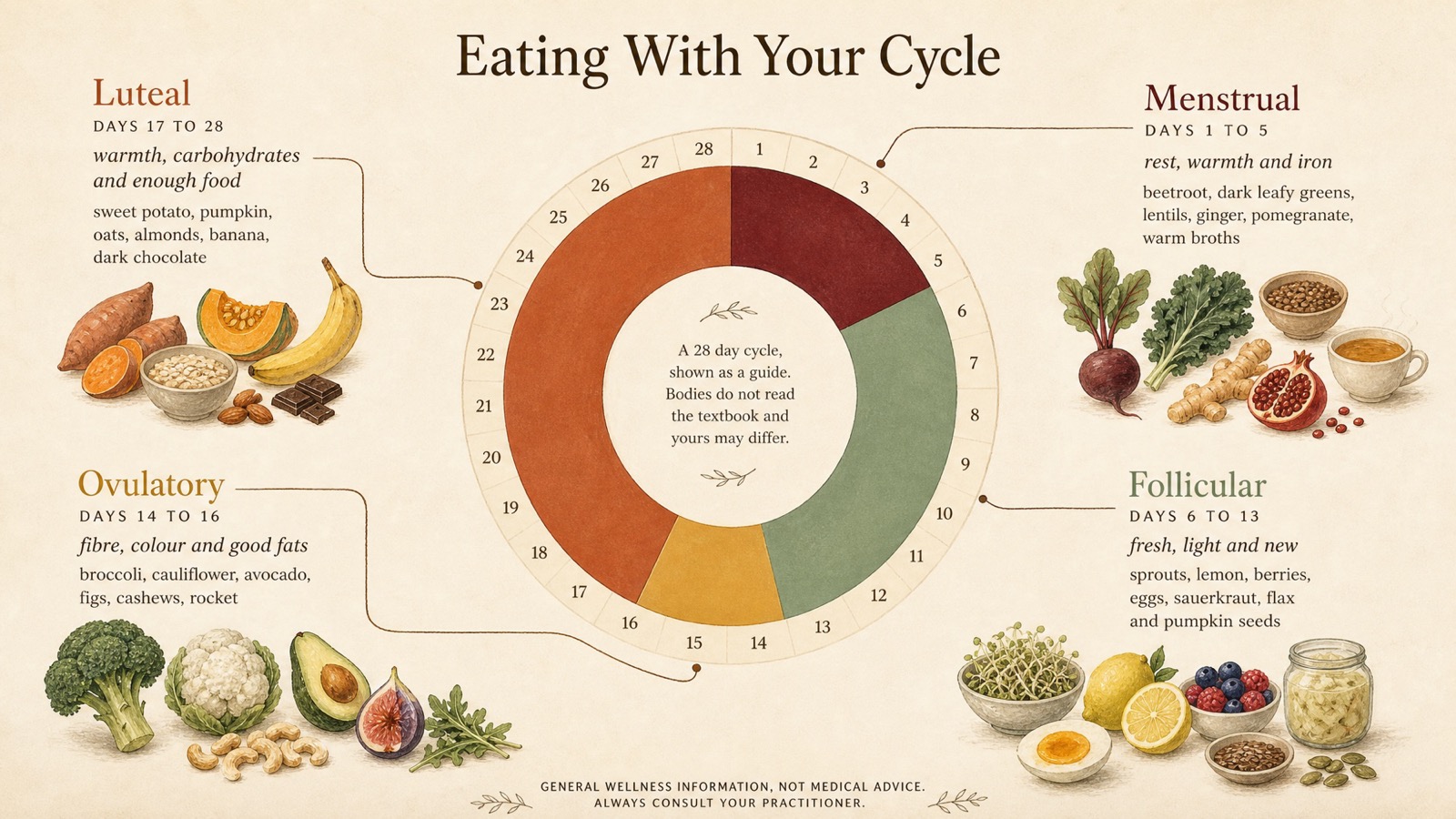
Menstrual phase
Roughly days 1 to 5
Oestrogen and progesterone are both low. Energy usually sits at its lowest point of the month, and appetite is often quieter than it was the week before.
What tends to feel right: warm, cooked and soft. Soups, broths, slow-cooked things, porridge, stewed fruit. This is the least appealing week of the month for a cold smoothie.
Foods to reach for: beetroot, dark leafy greens, lentils, ginger, pomegranate, warm broths, oily fish, eggs.
On iron. You are losing blood this week, so iron is worth being deliberate about. Lentils, beans, dark greens, red meat if you eat it. Vitamin C meaningfully improves how much iron your body absorbs from plant sources, so squeeze lemon over the greens and have the citrus with the meal rather than hours after it.
A lower carbohydrate week. Some women find this is the one stretch of the month where eating fewer carbohydrates suits them, and keto is the strictest version of that. Plenty of others feel worse for it. If you want to try it, keep the food coming while you do. Fewer carbohydrates means more protein and more fat in their place, not less on the plate, and this is not the week to be hungry.
The small thing that helps most: eating a little earlier in the evening, and sitting down to do it.
If you bleed heavily, or you are tired in a way that food does not touch, get your iron checked with a blood test rather than guessing at it. Low iron is common in menstruating women and easy to test for. Healthdirect covers it plainly if you are in Australia, and the NHS has the same ground if you are not.
Follicular phase
Roughly days 6 to 14
Oestrogen climbs. Energy comes back, and for most women so does the appetite for fresh food that felt like hard work a week ago.
What tends to feel right: lighter and brighter. Salads that are genuinely appealing now, fresh herbs, citrus, things that are crisp.
Foods to reach for: sprouts, lemon, berries, eggs, sauerkraut and other fermented food, flax and pumpkin seeds, green vegetables.
Worth knowing: this is the easiest stretch of the month to change something about how you eat. A new breakfast, a new way of cooking, a week of eating more simply. Start it here rather than in the fortnight before your period, because this is the phase with the energy for it.
If you are going to cleanse, cleanse here. In my own experience this is the only part of the month I want to go anywhere near a cleanse, a fast, or anything that asks something of my digestion. Energy is climbing, my appetite is steadier, and I have the reserves for it. The same thing attempted in the fortnight before my period has never once gone well for me. Before any cleanse goes through the questions worth sitting with first.
Ovulatory phase
Roughly days 15 to 17
A short, bright window. Oestrogen peaks and then falls away.
Ovulation itself is a moment, not a phase. The egg is released in the space of a day, somewhere in these few days, and what gets called the ovulatory phase is really the short window either side of it. That window is the part you can eat for.
What tends to feel right: fibre and colour. Digestion is often at its most capable here, and raw food goes down more easily than at any other point in the month.
Foods to reach for: broccoli, cauliflower, rocket, avocado, figs, cashews, olive oil, plenty of vegetables.
Lean into the fibre. If there is one week of the month to eat a great many vegetables, this is it. Big salads, cruciferous things, leaves, beans and lentils, the sort of plate that feels like hard work on day 24. The appetite for it is usually there on its own rather than being forced, so let it have its week.
Water, more than you think. Energy is high and most women are busier and more social here, which is exactly when drinking enough quietly stops happening.
Do not skip meals on the way down. Oestrogen falls away quickly once ovulation has passed, and the day or two after is where a lot of women notice a flat patch arrive out of nowhere. Regular meals through it make a difference you can feel.
About alcohol. This is the most social stretch of the month, and the one where a drink is most likely to be in front of you. It is also the one where women most often tell me it costs them more the next morning than the same drink would have a week earlier. Not a rule. Just worth knowing your own pattern before you are three deep at a dinner.
Luteal phase
Roughly days 18 to 28
The long one, and the phase that undoes most good intentions.
Progesterone rises, your resting metabolic rate goes up, and you are genuinely hungrier. That is the phase doing exactly what it does. It is not weakness and it is not a failure of willpower.
What tends to feel right: more food, and warmer food. Roasted things, stews, porridge, proper meals rather than grazing.
Foods to reach for: sweet potato, pumpkin, oats, brown rice, root vegetables, almonds, banana, dark chocolate.
Trying to eat in this fortnight the way you ate in your follicular one is how the second half of the month turns into a fight. Restriction here is what sets up the binge, and then the binge gets the blame instead of the restriction.
Because this is the stretch most women get stuck on, it has a post of its own. What to eat in your luteal phase goes properly into the hunger, the bloating, the chocolate and the things that quietly make it harder.
Four things that matter more than the food lists
If you take nothing else from this page, take these.
Eating enough, in every phase
Every list above assumes you are eating enough overall. Swapping sweet potato for salad is a rearrangement, not a solution, if the total is too low to begin with. Under-eating shows up as the second half of the month falling apart, every single month.
Eating regularly
Long gaps between meals land harder in some phases than others, and in the second half they tend to arrive as an emotion rather than as hunger. Irritability, tearfulness, a sudden certainty that everything is bleak. Something with substance every few hours takes more of the edge off that than any particular food does.
Warmth in the second half
Not a rule, just something almost every woman I talk to about this arrives at independently. Warm and cooked from ovulation onward, fresh and raw in the first half. Traditional systems have said this for a very long time, and I have no mechanism to offer you, only the observation that it holds up.
Listening to your body over the plan
Your cycle is not the same length every month. You can ovulate later than usual, your period can come early, and a hard fortnight can shift the whole thing. The days are a guide. Your body is the more reliable of the two.
So if you have done the shop, planned the meals, and then the food in the fridge is not the food you want, treat that as information rather than as failing at something. Cook the other thing. Move the salad to Thursday.
The women who get the most out of eating this way are not the ones following it most precisely. They are the ones who notice, and who are willing to change the plan.
Where to start with eating for your cycle
If you only do one thing, do this. Cooked and warm through your menstrual and luteal weeks. Fresh, raw and bright through your follicular and ovulatory ones.
That is the whole of it. No counting, no swapping individual ingredients, no working out whether the sweet potato belongs on a Tuesday. Soups, stews and roasted things in the two stretches where your body turns inward. Salads, fruit and crunch in the two where it opens out. Give it a month or two and notice whether you feel any different.
It is simple enough to hold in your head in the supermarket, which is the only place a rule ever has to survive.
If you would rather not work the whole month out from scratch, I have already done that part.
My free guide to balancing your hormones takes the four phases one at a time and sets out what each one asks for, with a chart you can keep somewhere you will see it.
The Nourished Woman is my recipe book, if you would like the cooking already worked out for you.
Questions women ask about eating for your cycle
Do I have to change my food four times a month?
No. Most of what your body wants is the same in every phase, and the shifts are small. Warmer or lighter, a little more or a little less. If you only ever changed one thing, eating more in your luteal phase would be it.
What if my cycle is not 28 days?
Very few are. Count your own phases from your own day 1, and use the diagram as a shape rather than a calendar. What matters is that you know roughly when you ovulate, because that is the hinge the second half swings on.
Can I eat for my cycle if I am on the pill?
Hormonal contraception works by holding your hormones steady, so there is no natural rise and fall to follow. Eating well still matters, of course. If you are coming off the pill and waiting for your own rhythm to return, that is its own particular season and worth reading about before you are in the middle of it.
What about cravings?
Cravings in the second half of the month are close to universal and they are not a moral event. Have the chocolate, sitting down, deliberately, and get on with your day. The energy women spend resisting, giving in and then feeling ashamed is enormous and completely wasted.
What about seed cycling?
Seed cycling is the practice of eating flax and pumpkin seeds through the first half of your cycle, then sesame and sunflower seeds through the second. A tablespoon or so of each a day, ground or whole, stirred through whatever you are already making.
It comes out of naturopathic practice, where the two halves of the month have long been worked with differently, and it has travelled a long way through the wellness world since. Many women love it, and the ones I know who keep it up tend to say the same thing: it is a small daily ritual that keeps them aware of where they are in their month.
All four are lovely food in their own right, and they cost almost nothing, so it is an easy one to try for a couple of cycles and see how you find it.
How long before I notice anything?
Two or three months, because that is how long it takes to see your own pattern rather than somebody else's chart.
Where to go next
The four phases of your cycle takes the same month and looks at everything other than food: energy, mood, what to schedule and what to protect.
How to track your cycle is the practical starting point, from a one-line diary through to temperature and cervical mucus.
What to eat in your luteal phase is the deep version of the hardest fortnight.
And if digestion is the part that bothers you most, how to food combine is a gentler place to begin than another set of phases.
If you would like a framework for the food itself rather than for the month, the five flavours of Chinese medicine is one of the oldest there is, and it asks you to count nothing.
If something about your cycle has changed and you are not sure whether it matters, the symptoms worth raising is where I would start.
Sisters, you are not inconsistent. You are cyclical, and your appetite has been telling you that all along.
With love,
Jodie Louise
More on hormones
 What to Eat in Your Luteal Phase: The Two Weeks Before Your Period
The luteal phase is the stretch between ovulation and your period. Roughly two weeks, days 18 to 28, though bodies do not read the textbook and yours may run to a different clock.
What to Eat in Your Luteal Phase: The Two Weeks Before Your Period
The luteal phase is the stretch between ovulation and your period. Roughly two weeks, days 18 to 28, though bodies do not read the textbook and yours may run to a different clock.
 Cyclical Living: Unlock Your Feminine Superpowers
For a stretch of the month you feel unstoppable, and a fortnight later you cannot face the list you wrote. Nothing has gone wrong with you. Here is what each phase tends to ask for, and how to plan a month around it.
Cyclical Living: Unlock Your Feminine Superpowers
For a stretch of the month you feel unstoppable, and a fortnight later you cannot face the list you wrote. Nothing has gone wrong with you. Here is what each phase tends to ask for, and how to plan a month around it.
 How to Track Your Cycle & Find Your Own Monthly Pattern
Your body is not the same woman on day four as she is on day fourteen, and she keeps changing all the way through. Here is how to follow your own rhythm, and what it can show you that a single day of testing never will.
How to Track Your Cycle & Find Your Own Monthly Pattern
Your body is not the same woman on day four as she is on day fourteen, and she keeps changing all the way through. Here is how to follow your own rhythm, and what it can show you that a single day of testing never will.