
Wondering how to food combine for optimal digestion?

Food combining means paying attention to what goes on the plate together. Fruit on its own and on an empty stomach. Protein and starch in separate meals. Vegetables with almost anything. A gap between meals rather than grazing. It is a traditional practice rather than a clinical one, and the simplest way in is to change one meal, not all of them.
It is not always what you eat, it is how
Different foods digest at different speeds, and they lean on different enzymes to break them down. Food combining is simply the practice of paying attention to that, and to what you put on the plate together.
Most women who come to this have a digestion that feels sensitive. A belly that is working well should be able to handle a mixed plate without much thought, and plenty of them can. But if you are someone who notices food more than most, simplifying what lands on the plate together is a gentle place to start, and your own body will tell you soon enough whether it makes any difference for you.
I should say early that this is a traditional practice and my own experience of it, not a clinical one. I would never tell you what it will do for your body, because that part is yours to notice. You will also find many different beliefs around it. What I can tell you is where it comes from, what the rules actually are, and how to try it without turning dinner into an exam.
Two things before we go on. This is a guide, so if a doctor or a practitioner has given you advice about how to eat, theirs comes first and none of this replaces it. If your digestion has been difficult for a long time, or something has changed, that is a question for them rather than for a chart.
And if you have any history of disordered eating, I would skip this one. Food combining asks you to think about food a great deal, and that is not a neutral thing to hand to everybody.
Where food combining comes from
The principles are old, though they come from two different places, and it is worth knowing which is which.
The older one is Ayurveda, the system of medicine that grew up on the Indian subcontinent. It puts digestion near the centre of everything, and it has a word for the body's digestive capacity, agni, usually translated as digestive fire. It also has a name for the pairings it treats as incompatible, viruddha ahara, set down in its classical texts around two thousand years ago. Milk with fish is one of them. Milk with sour fruit is another.
Ayurveda also describes food by its qualities rather than its nutrients: heavy or light, warming or cooling, wet or dry. Combining, in that language, is a question of whether those qualities sit well together on the one plate. Chinese medicine sorts food a similar way, by the five flavours and by whether a food is warming or cooling.
The rules you are most likely to have seen, though, are barely a hundred years old. Separating protein from starch, and eating fruit on its own, came from an American doctor named William Hay in the early twentieth century, and were carried further by Herbert Shelton in the decades after him. The two often get folded together and offered as one ancient system, which is a shame, because they are lovely for different reasons.
So that is where it all comes from. What follows is the practice itself, and it is simpler than its history.
The food combining chart
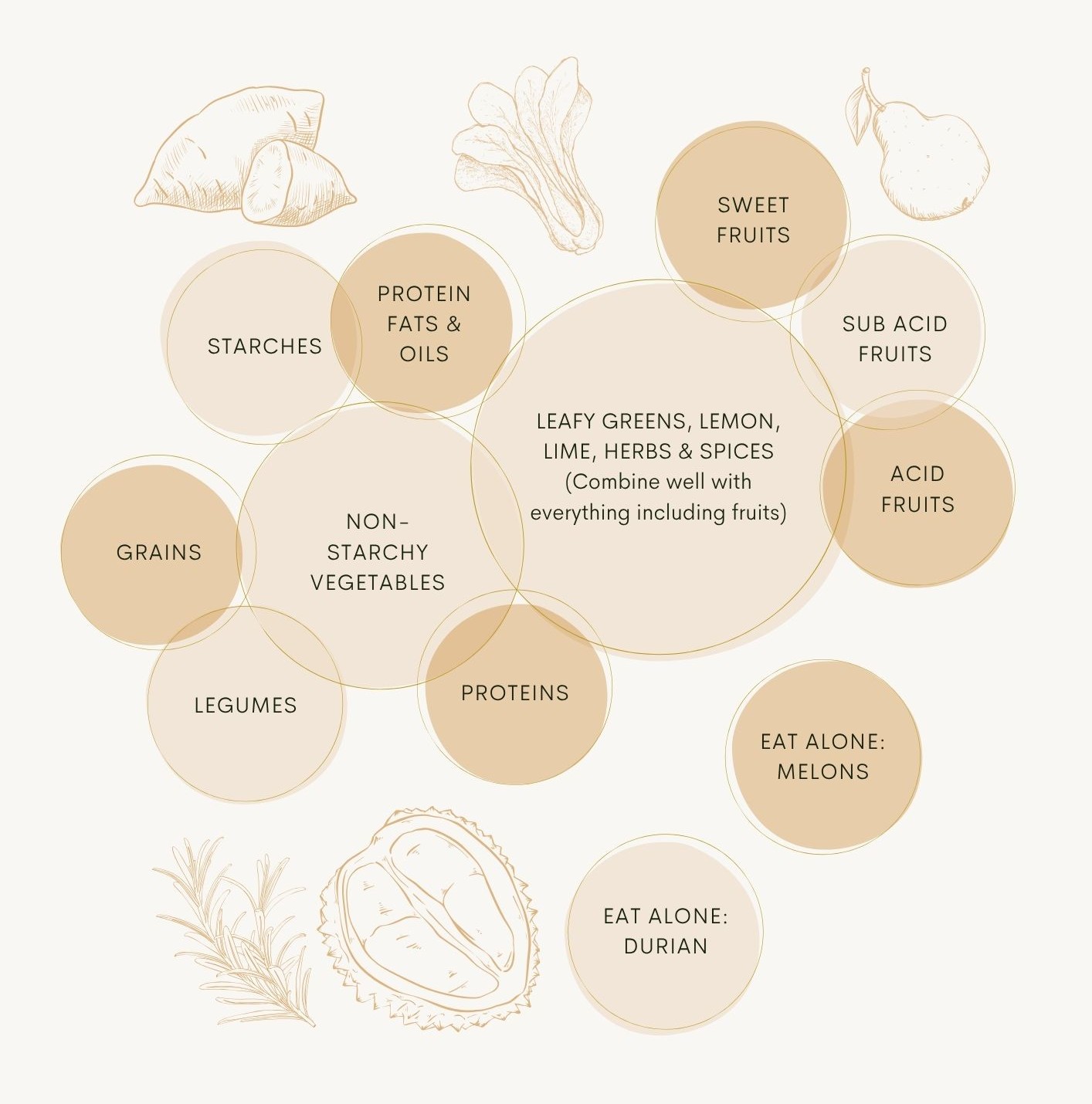
Only combine the foods whose circles overlap. Everything below is that chart in words, and there is a larger version you can print on the food combining chart page.
The principles of food combining
Fruit on its own & on an empty stomach
Fruit moves through quickly. Put it behind a heavy meal and it waits. Melon in particular is traditionally eaten alone.
Protein & starch separately
The classic one, and the one people find hardest, because it rules out most of how we eat. Meat and potatoes. Cheese and bread.
Non-starchy vegetables go with almost everything
Leafy greens, salad leaves, broccoli, zucchini and the like. Potatoes, pumpkin and corn are starches, so they follow the rule above. Which makes this far less restrictive than it first sounds.
Leave time between meals
Grazing gives the whole system no gap to finish anything.
A good place to start
Not all of it at once. I tried that and it made me miserable and slightly insufferable at dinner parties.
Pick the one that sounds most likely to matter for you. For most people that is fruit, because it is the easiest to apply, and in my opinion it is the one where you are most likely to notice something.
Then treat it as an experiment rather than a rule. Give it two weeks and pay attention. If you have been uncomfortable after meals, and you change how you eat fruit and find you are sitting easier, that is worth knowing and worth keeping. If nothing shifts, you have lost nothing, and you can let it go without any sense that you have failed at something.
The rule I would actually keep, if I could only keep one: do not eat while braced. Sitting down, chewing properly and not doing three other things matters more in my experience than any pairing rule on any chart.
How I apply this in my life
I spent years trying to fix my diet. I drank more water, exercised more, cut things out, added things in. I had gas and bloating, acne and digestion that made no sense to me, and none of the usual advice touched it.
What eventually shifted things was paying attention to how I was eating rather than only what. Slower. Simpler plates. Fewer competing things at once. It sits alongside everything else I have written about looking after your digestion.
That is my own experience, and I share it as that. Your body may tell you something completely different, and it is the more reliable source. Learning to hear it is what intuitive eating is really about.
Questions I get asked
Can you eat fruit after a meal?
Traditionally, no. Fruit moves through quickly, so the thinking is that it sits and waits behind anything heavier. The usual suggestion is fruit first, on a fairly empty stomach, and twenty minutes or so before the rest. Melon is the one most often eaten completely on its own.
What foods should not be eaten together?
The pairing most people mean is protein with starch. Meat with potatoes, cheese with bread. Ayurveda names different ones again, milk with fish and milk with sour fruit among them. The chart above is the short version of both.
Does food combining actually work?
It depends who you ask, and on you. Western nutrition largely does not teach it, and you will find people who swear by it and people who dismiss it. What I can say is that a good many women notice something when they eat more simply, and the only way to find out which you are is to change one thing and pay attention.
How long should you leave between meals?
Three or four hours is the usual suggestion, so that one meal has finished before the next one starts. Grazing is really what this rule is aimed at.
Can you eat protein & vegetables together?
Yes, and this is the one that makes the whole thing livable. Non-starchy vegetables go with almost everything, so a piece of fish and a plate of greens breaks no rule at all.
The How to Food Combine book
You have the chart above, which is the shape of the whole thing. What I could not fit onto one page is everything I worked out by living with it, so I gathered that into How to Food Combine, part of my Nourished Woman movement.
It is a short e-book and a practical one. My own findings, the tips and tools I reach for, and the way I put a plate together on an ordinary day, which is a different thing from knowing the theory.
Everything above is enough to start with, though. The book is there if you want the way I do it.
With love,
Jodie Louise
More on digestion
 The Food Combining Chart: What Goes Together & What to Eat Alone
A food combining chart you can read in a minute and print for the fridge. Which food groups go together, which to keep apart, and what to eat on its own.
The Food Combining Chart: What Goes Together & What to Eat Alone
A food combining chart you can read in a minute and print for the fridge. Which food groups go together, which to keep apart, and what to eat on its own.
 What Are Plant-Based Digestive Enzymes & What Do They Do?
What plant-based digestive enzymes are and what they actually do, and why I would look at how and when you eat before reaching for a supplement.
What Are Plant-Based Digestive Enzymes & What Do They Do?
What plant-based digestive enzymes are and what they actually do, and why I would look at how and when you eat before reaching for a supplement.
 Intuitive Eating: Learning to Trust My Body Again
A gentle note before you begin. How we eat is a tender thing, and often a deeply wired one, so any method that asks you to change it deserves to be approached carefully. If you have a history of…
Intuitive Eating: Learning to Trust My Body Again
A gentle note before you begin. How we eat is a tender thing, and often a deeply wired one, so any method that asks you to change it deserves to be approached carefully. If you have a history of…