
Rose Cacao Ritual: A Ceremonial Cacao Recipe for an Open Heart
This page contains affiliate links, and I earn a commission, which never changes what you pay. Always read the label and follow the directions for use.

Cacao has been close to my heart for as long as I can remember. I felt connected to it when I was young, long before I knew there was such a thing as ceremonial cacao, and once I found it I sat in hundreds of cacao circles and ceremonies over the years and eventually did a training in it. I believe I was a cacao shaman in a past life. For me it is a sacred plant and a true ally: it opens my heart every time, and honouring the wisdom of cacao, the way it has been drunk and held for thousands of years, is part of every cup I make.
So I thought I had long since settled how I liked it. Then a jar of Anima Mundi's rose powder landed on the bench, a quarter of a teaspoon went into the blender to see what would happen, and it has been my favourite new addition ever since.
It has become my favourite ritual, too. Every cup of it feels like drinking a big hug: warm in the belly, and the heart-opening feeling I get from cacao and rose together is so profound for me that I make it for friends whenever they are here. It is the kind of thing you want to share. And you need so little of the powder that the jar goes a very long way.
It is, honestly, divine. So this is the rose cacao ritual, the way I actually make it. Ceremonial cacao, a little maca, rose powder, a pinch of vanilla, your sweetener of choice if you like one, and hot water. No milk, thirty seconds in the blender, and then all the time you can give it.
Why rose in cacao
Rose has been in the kitchen a great deal longer than it has been in the wellness aisle. Across Persia, India and the Ottoman world it has been stirred into sweets and drinks for centuries: rose water in sherbet and in the syrup poured over baklava, rose in lokum, rose milk against the summer heat of the subcontinent, petals dried and crumbled into the spice mixes of Iran.
Rose and chocolate are an old pairing too. Rose, vanilla and cacao turn up together in Persian and Turkish sweets whenever chocolate does, and once you taste them in the same cup it is obvious why. Rose is floral and faintly tart, cacao is deep and bitter, and vanilla rounds the edge between them. That is pairing by flavour rather than by fashion, and it is the only reason this cup works.
The powder I use is Anima Mundi's Rose Powder: dried Rosa centifolia petals, ground fine, nothing added, and my favourite thing they make. I love the aroma. A quarter of a teaspoon is enough to fill the whole cup with rose and lay a soft floral note under the cacao. The cup itself still looks like cacao. It is a strong flavour in a small amount, so start there rather than with the half teaspoon on the jar, and add a little more next time if you want it more floral.
Two sacred plants: cacao & rose in ceremony
Both of these have been drunk in ceremony for a very long time. The Maya and the Mexica took cacao at weddings, at rites of passage and as an offering, frothed by pouring it from a height, spiced with chilli and vanilla, and rarely sweet. The beans were currency and the drink was kept for the sacred and the powerful, and when Linnaeus came to name the tree he called it Theobroma: food of the gods. A modern cacao circle, where the cup is passed from hand to hand and drunk with intention, is that tradition carried forward, and it is where I first learnt to drink cacao slowly.
Rose has been the flower of the heart in almost every tradition that grew it. Persian rose water is sprinkled over guests at weddings and over the thresholds of shrines, the Sufi poets made the rose their image of the beloved and of the opened heart, petals are offered in temples across India, and the rosary took its name from a garland of roses. Both plants have been used, for thousands of years, to mark the sacred, to open a ceremony and to say that this moment matters.
So this cup borrows from both. You do not need a circle, a facilitator or anyone's permission. You need the cacao, the rose, a quiet five minutes and the willingness to treat them as more than a drink.
What ceremonial cacao is & how to make it with water
Ceremonial cacao is the whole bean, fermented and ground into a paste with all of its fat still in it. It comes as a solid block or as discs and it melts like chocolate, because that is essentially what it is, minus the sugar. Cacao powder is that same paste pressed to remove most of the cacao butter and then dried, which is why a cup made with powder is thinner and drier in the mouth, and a cup made with the paste is glossy and full.
Because the fat is still there, ceremonial cacao does not need milk to be rich, and that is the whole reason I make it with water. Milk, even oat or almond, blankets the flavour, and the rose disappears under it. Water keeps the cup light, at any hour, and lets the rose and the vanilla come through. The blender does the rest: thirty seconds on high whips the cacao butter into the water so it pours with a proper froth.
Cacao is also the most forgiving base of all the cups I make, rich and bitter enough to carry earthier things without tasting of them, which is why the maca here reads as caramel rather than as maca.
Rose Cacao Ritual recipe
Serves one.
Ingredients
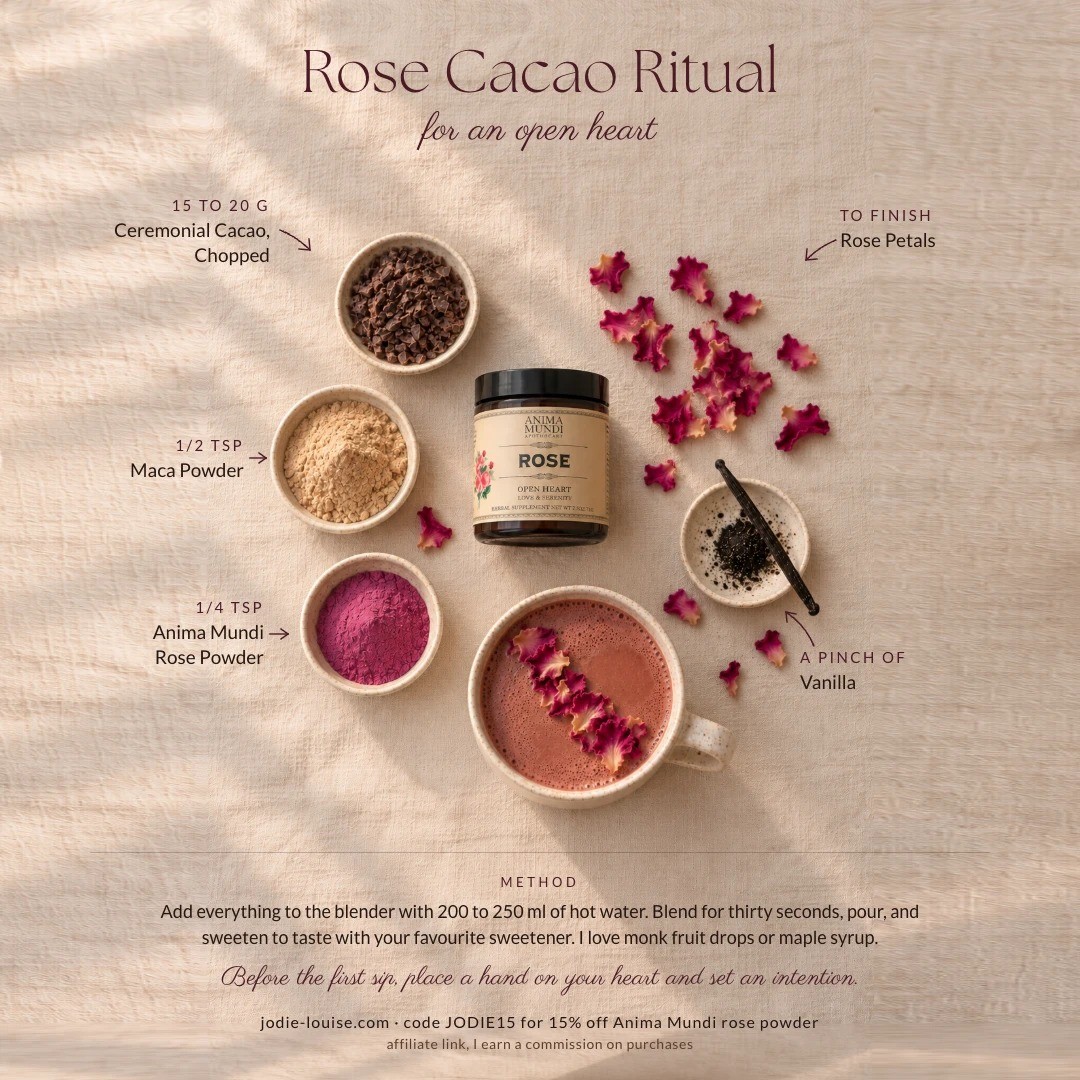
- •15 to 20 g ceremonial cacao, finely chopped or shaved (about a heaped tablespoon once chopped)
- •1/4 teaspoon Anima Mundi Rose Powder
- •1/2 teaspoon maca powder
- •A pinch of vanilla bean powder, or the seeds scraped from a small piece of pod
- •Sweetener of choice, optional: I use 3 to 4 drops of monk fruit, or a teaspoon of maple syrup when I want it richer
- •200 to 250 ml hot water, around 70 to 80 degrees (let the kettle sit for a minute or two after it boils; cacao is never boiled)
- •A few dried rose petals to finish, if you like
Method
- Chop the cacao fine. The finer it is, the faster it melts and the smoother the cup.
- Everything into the blender: cacao, rose powder, maca, vanilla, and your sweetener if you are using one.
- Pour the hot water over and blend for thirty seconds, until it is glossy and frothy.
- Pour, and scatter a few dried rose petals over the froth if you have them.
- Before the first sip, place a hand on your heart and set an intention. Then drink it slowly.
Maca gives the cup a malty, caramel depth under the cacao. The vanilla rounds the slight tartness of the rose. It needs no sweetener at all if you like cacao dark; monk fruit sweetens it without tasting of anything, and maple makes it richer and closer to a dessert. There is no salt and no milk in mine, and I would try it that way at least once before you change anything.
Make it a ceremony & drink with an open heart
The recipe is the easy part. The ritual is what you do with the cup once it is in your hands. Put the phone somewhere else, sit down, and take a moment to be with yourself: a hand on your heart, a breath, an intention for the hour ahead or for nothing at all. Then drink it slowly, the same way I try to eat slowly enough to taste what I am eating.
Cacao has been called the heart opener in its own tradition for as long as it has been drunk in ceremony. That is the tradition's word for it, and it fits. In a circle the cup is passed from hand to hand, and I think it is at its best when it is shared: make two, and sit with a friend or someone you love while you drink them. Some days that is first thing, some days it is four in the afternoon, when the day needs a pause more than it needs another coffee. Whenever it is, give it the whole five minutes. That is the ritual, and it is the whole point.
Where to buy it & the Anima Mundi discount code
Anima Mundi Rose Powder is the one on my cupboard shelf, and I am so in love with the packaging that some weeks the jar lives on my altar instead. Inside it is ground Rosa centifolia petals, grown in India, and nothing else. My Anima Mundi discount code is JODIE15, for 15% off anything on their site. If you are in Australia, Anima Mundi's stockists are listed on their site; my own jar came through their Australian distributor.
The ceremonial cacao in the recipe is Harmoni Ritual Ceremonial Cacao. Maca, vanilla and whichever sweetener you like come from any good grocer, and the dried petals from the same place you buy your tea.
More from the kitchen
- •For Your Everyday, where the rose powder sits on the cacao and morning cup shelf with everything else I keep on hand
- •The Nourished Woman, my recipe book, if you would like the rest of the day's cooking worked out for you
- •How to Intuitively Eat, my book on eating the way this cup is meant to be drunk
With love,
Jodie Louise
More on nourishment
 The Truth About Hydrogen Water Bottles: Five Things to Check
This is an expensive category full of confident claims. Here is what a hydrogen water bottle actually is, the five things worth checking, what two independent laboratories measured, and why I would rather you were sceptical than sold to.
The Truth About Hydrogen Water Bottles: Five Things to Check
This is an expensive category full of confident claims. Here is what a hydrogen water bottle actually is, the five things worth checking, what two independent laboratories measured, and why I would rather you were sceptical than sold to.
 How to Balance Health with the Five Flavours of TCM
The five flavours are sweet, sour, bitter, pungent and salty. Traditional Chinese medicine associates each one with a season and a part of the body, and the idea is not that any flavour is good…
How to Balance Health with the Five Flavours of TCM
The five flavours are sweet, sour, bitter, pungent and salty. Traditional Chinese medicine associates each one with a season and a part of the body, and the idea is not that any flavour is good…
 The Food Combining Chart: What Goes Together & What to Eat Alone
A food combining chart you can read in a minute and print for the fridge. Which food groups go together, which to keep apart, and what to eat on its own.
The Food Combining Chart: What Goes Together & What to Eat Alone
A food combining chart you can read in a minute and print for the fridge. Which food groups go together, which to keep apart, and what to eat on its own.