
What to Eat in Your Luteal Phase: The Two Weeks Before Your Period

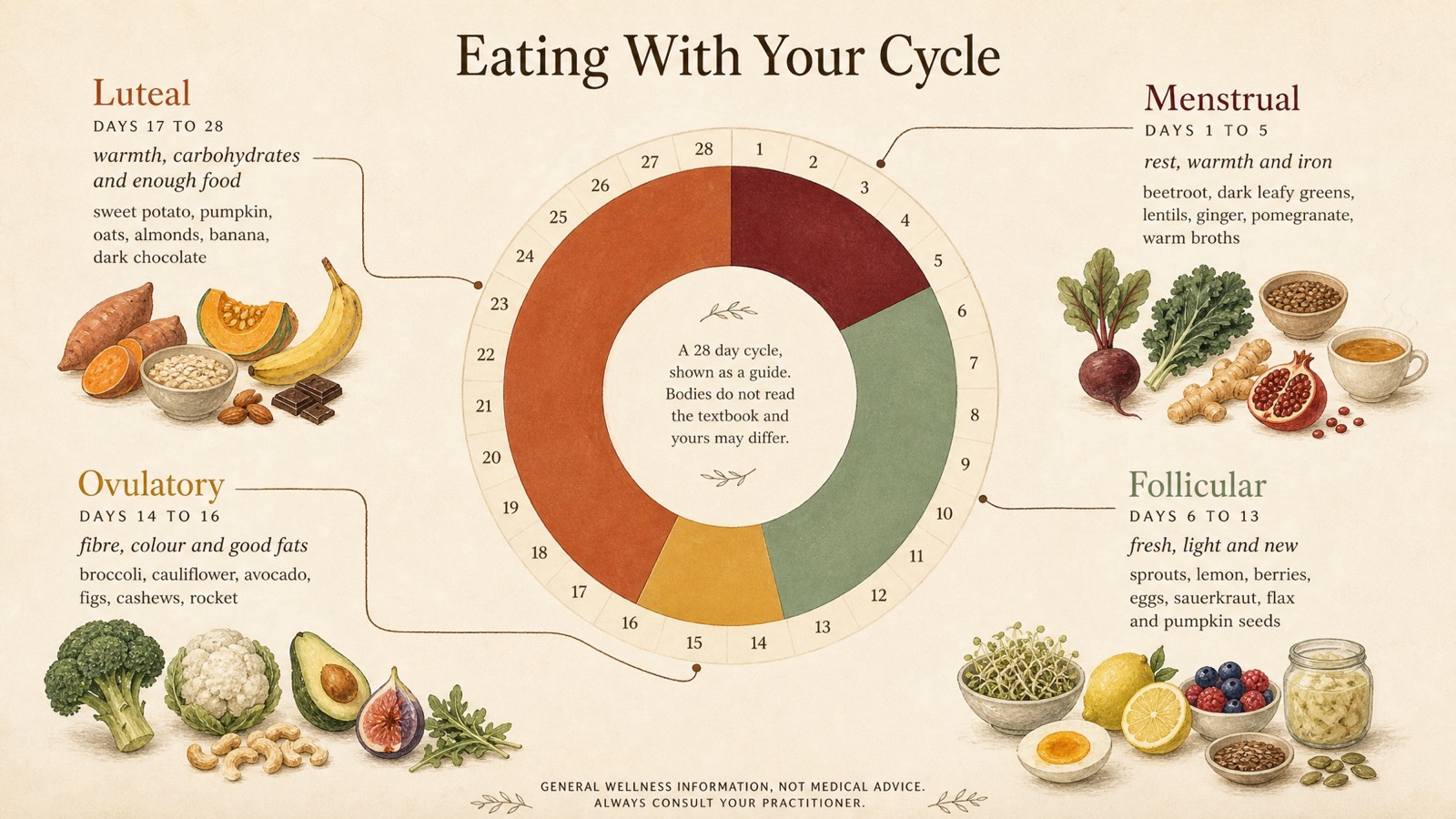
The luteal phase is the stretch between ovulation and your period. Roughly two weeks, days 18 to 28, though bodies do not read the textbook and yours may run to a different clock.
Day 1 is the first day of proper bleeding, not spotting, and every other day counts forward from there. The day numbers here run on a 28 day cycle, because the numbers have to start somewhere. Yours may be shorter or longer and be completely normal: both Jean Hailes here in Australia and the Cleveland Clinic put the usual range well either side of 28 days. What matters is not the date on the calendar, it is knowing roughly when you ovulate, because that is the hinge your second half swings on.
It is also the phase where most women I know quietly decide they have failed at something.
You were doing so well. Eating beautifully, energy up, everything working. Then somewhere around day 20 the wheels come off, you want bread and chocolate and to be left alone, and the story you tell yourself is that you have no self control.
You have a luteal phase. That is the whole of it.
Why you are so hungry before your period & why it is not a character flaw
Your body really does more work in this phase. Resting metabolic rate is measurably higher in the luteal phase than in the follicular one, and while the studies vary on the size of it, the direction is consistent and it has been observed for decades. Five of the six studies that compared the two phases directly found the luteal one higher, by something like three to five per cent.
So the hunger is real. It is not psychological, it is not weakness, and it is not something to be overridden with discipline.
Here is the part I wish someone had told me sooner: when I restricted in this phase, I binged. Every time, and then I blamed myself for the binge rather than for the restriction that caused it. Learning to eat intuitively was what finally broke the loop.
The luteal phase asks for more food, not less. Meeting it is the intervention.
Luteal phase foods: what actually helps
I want to be honest about the evidence here, because there is a great deal of confident writing on this topic that is running well ahead of what is known. Specific nutrient protocols for this phase are studied much less thoroughly than the internet suggests, and I am not going to hand you a supplement list dressed up as science.
What I can give you is what is well established, plus what a lot of women independently arrive at.
Eat enough & eat regularly
The single most useful thing here, and the easiest one to skip.
Long gaps between meals hit harder in this phase. Blood sugar swings feel worse, and the crash tends to arrive as an emotion rather than as hunger: irritability, tearfulness, a sudden conviction that everything is bleak. Eating something with substance every few hours takes the edge off that more reliably than any specific food.
Protein at every meal
The thing that makes eating enough actually work.
Protein slows a meal down. It softens the blood sugar climb and drop that a plate of mostly carbohydrate gives you, and it keeps you full for longer, which counts for more in this fortnight than in any other. Eggs, fish, chicken, yoghurt, lentils, beans, tofu. Nothing needs weighing. It just needs to be there at each meal, rather than turning up only at dinner.
Complex carbohydrates, unapologetically
This is the phase to stop being frightened of carbohydrates.
Oats, sweet potato, brown rice, quinoa, root vegetables, proper bread. Your body is asking for them and the asking is not a malfunction. Low-carbohydrate eating that felt fine in your follicular phase can feel miserable in your luteal one, and that is worth noticing rather than pushing through.
Warm & cooked, over raw & cold
Not a rule, just something almost every woman I have talked to about this lands on independently.
Soups, stews, roasted things, porridge. A big raw salad that felt perfect on day 8, back in your follicular week, often feels like hard work on day 24, when you are well into your luteal phase. Traditional systems have said this for a very long time, and it holds up.
Iron, before you need it
You are about to bleed. Lentils, beans, dark greens, and red meat if you eat it.
There are two kinds of iron and they behave differently, which is worth knowing because it changes what you put on the plate.
The iron in meat is the easy one. Your body absorbs it well on its own, so if you are eating red meat you do not need to pair it with anything.
The iron in plants is harder for your body to take up, and that is where vitamin C makes a real difference. So if your iron is coming from lentils, beans or greens, put something with vitamin C on the plate at the same time: lemon squeezed over the greens, tomato through the lentils, capsicum in the salad.
If you bleed heavily, or you are exhausted in a way that food does not touch, get it checked properly with a blood test. And ask for ferritin, not only a full blood count. Ferritin is your iron stores, and it can sit low for a long time before anything turns up in the standard result, which is how a great many women get told everything looks normal while feeling anything but.
The things worth taking to that appointment: tiredness that sleep does not fix, breathlessness on stairs you used to manage without thinking, more hair than usual in the brush, cold hands, restless legs at night. Any one of those on its own can be a dozen different things. Several of them together, alongside heavy periods, are worth a test rather than a guess.
Magnesium-rich foods
Dark leafy greens, pumpkin seeds, almonds, black beans, and yes, dark chocolate.
Magnesium is the one I keep coming back to, and the evidence is strongest for cramps. A Cochrane review of dietary supplements for period pain found magnesium beat a placebo in two trials out of three. They were small trials and a third of the women did not finish, so hold it loosely, but that is more than most things in this conversation can say.
Timing seems to matter as much as amount. The trials that worked started in the week before bleeding rather than waiting for the cramps to arrive, which is the argument for eating these foods now, in the fortnight when nothing hurts yet.
Magnesium also draws water into the bowel, so these are the foods to reach for if things slow down in the second half of your cycle.
Sleep is where I notice it most, and it is the reason I keep coming back to it. I sleep more deeply, my digestion is easier, and my nervous system settles in a way I can feel. My partner says exactly the same. That is my experience rather than a promise about yours, but it is the one I would be least willing to give up.
The chocolate
Have the chocolate.
I mean this seriously. The craving is close to universal in this phase, and the amount of energy women spend resisting it, then giving in, then feeling ashamed, is enormous and entirely wasted. Eat it sitting down, on purpose, the way you would eat anything you had chosen.
Do turn the packet over first, though. A great deal of what sits in the chocolate aisle is confectionery wearing chocolate's name, and it is the cacao that carries everything worth having. You want cacao solids high on the ingredients list and sugar well down it, rather than the other way about. Seventy per cent and up is a sensible place to start. If the fat listed is vegetable oil instead of cocoa butter, put it back on the shelf.
Cacao is one of the loves of my life, and has been for years. I have studied it, I sit in ceremony with it, and most weeks there is a pot of it on my stove with whatever herbs I am working with stirred through. It is my favourite ritual of all of them, and this is the fortnight I want it most.
If you are looking for somewhere to start, my rose cacao ritual is the cup I reach for in this week, and there is a cacao and morning cup shelf on For Your Everyday, with ceremonial and everyday cacao on it and a decaffeinated coffee. Please note, I earn a commission if you buy through those links.
What tends to make it harder
Not rules. Just the things I notice when I get it wrong.
Sugar on its own
A biscuit eaten standing up in the kitchen at four o'clock, with nothing else anywhere near it, gives you a climb and then a drop, and in this fortnight the drop tends to arrive as a mood rather than as hunger. The same biscuit after a proper meal barely registers.
That is why the chocolate sits in the section above this one and not in this one. What costs you is not the sweetness. It is the sweetness on an empty stomach.
Alcohol
Sleep in this phase is often already lighter, and alcohol makes that worse in a way you feel the next day more than usual.
Caffeine on an empty stomach
I would not recommend this to a woman at any point in her cycle. Coffee before food asks your body for a stress response before you have given it anything to work with, and the drop that follows costs more than the lift was worth.
In this fortnight it is worse again. Your sleep is already lighter, the blood sugar swings are already sharper, and the crash still tends to arrive as an emotion rather than as hunger. If you want the coffee, and I do, have it after breakfast rather than instead of it.
Eating late & eating rushed
Digestion tends to feel slower here, and standing at the counter at nine at night is a different experience in this phase than in the first half.
Deciding this is the week to start something
New regime, new restriction, new plan. It is the worst possible timing and it is precisely when the self-critical voice tends to suggest it.
Luteal phase bloating
Almost everybody asks about this, so: some fluid retention and abdominal bloating in the second half of the cycle is extremely common and it is not a sign that anything has gone wrong. It usually eases as your period arrives.
Warm food, enough water, salt you can taste rather than salt hidden in packaged food, and gentle movement all seem to help. Wearing something you are not fighting all day helps more than any of them. And if it is wind rather than fluid that is bothering you, that is its own particular indignity and it has its own post.
If bloating is severe, painful, or does not go away when your period comes, that is a doctor's question. There are conditions that present this way and they are worth ruling out properly rather than managing with soup.
What this phase is actually for
I have come to think the luteal phase gets a bad reputation it does not deserve.
The energy turns inward. Tolerance for nonsense drops. Things you have been politely ignoring for three weeks become impossible to ignore, which is inconvenient and also frequently correct. The luteal phase is where I do my clearest thinking about what is not working in my life, even though it is the phase where I am least fun to be around.
It asks for warmth, food, sleep and less of everything else. That is not a phase to be fixed. It is a phase to be resourced.
If you can, put fewer things in this fortnight. Cook a bit more, plan a bit less, and stop scheduling the difficult conversation for day 26.
This is your inner autumn, if that way of thinking speaks to you. Cyclical living walks through all four seasons of your month, and what each one tends to ask of you.
Every phase asks for something different
Your luteal phase is not a worse version of your follicular one, it is a different set of needs. Seeing the whole month laid out is what made that click for me, because the food that suits me on day 8 is not the food I want anything to do with on day 24. Eating for your cycle walks through all four phases one at a time.
28 days is the guide, not the rule. Your own phases may run longer or shorter, which is exactly why the days matter less than learning your own pattern.
Questions women ask about the luteal phase
Why am I so hungry before my period?
Because your body is doing more work. Resting metabolic rate rises in the second half of your cycle, and the hunger you feel is your body asking for what it is actually spending. It is not a lapse in willpower.
Should I eat more in my luteal phase?
Usually, yes, and it is the single most useful change most women make. Restricting in this phase tends to backfire, and eating enough, regularly, takes the edge off the mood more reliably than any particular food does.
How long is the luteal phase?
Roughly 12 to 14 days, counted from ovulation to the day your period starts. On the diagram above, where the few days around ovulation get a band of their own, it shows as days 18 to 28. Very few cycles are exactly 28 days, so the length that matters is yours, not the textbook one.
Why do I bloat before my period?
Fluid retention and bloating in the second half of the cycle are very common and usually settle once you bleed. If it is severe, painful, or does not go away when your period comes, that is one to take to a doctor.
Is it normal to want chocolate before my period?
Close to universal, and not a moral event. Have it, sitting down, on purpose. Make it a proper dark one though, with cacao high on the ingredients list and sugar well down it, because the cacao is where everything worth having actually sits.
Where to go next
This phase makes far more sense once you can see the whole month it sits inside. The four phases of your cycle walks through all of them and what each one tends to ask for.
And you cannot work with your luteal phase if you do not know when it starts, which is really an ovulation question. How to track your cycle covers the ways of working that out.
There is also a free guide to working with your hormones that goes through each phase, if you want something to keep.
Sisters, you are not failing at the second half of your month. You are living in it, and it has been asking you for more food all along.
With love,
Jodie Louise
More on hormones
 Eating for Your Cycle: What to Eat in Each of the Four Phases
Around day eight, a big raw salad is exactly what I want. By day 24 the same salad looks like homework. For years I read that as inconsistency. One week I was the woman who ate beautifully, the…
Eating for Your Cycle: What to Eat in Each of the Four Phases
Around day eight, a big raw salad is exactly what I want. By day 24 the same salad looks like homework. For years I read that as inconsistency. One week I was the woman who ate beautifully, the…
 Cyclical Living: Unlock Your Feminine Superpowers
For a stretch of the month you feel unstoppable, and a fortnight later you cannot face the list you wrote. Nothing has gone wrong with you. Here is what each phase tends to ask for, and how to plan a month around it.
Cyclical Living: Unlock Your Feminine Superpowers
For a stretch of the month you feel unstoppable, and a fortnight later you cannot face the list you wrote. Nothing has gone wrong with you. Here is what each phase tends to ask for, and how to plan a month around it.
 How to Track Your Cycle & Find Your Own Monthly Pattern
Your body is not the same woman on day four as she is on day fourteen, and she keeps changing all the way through. Here is how to follow your own rhythm, and what it can show you that a single day of testing never will.
How to Track Your Cycle & Find Your Own Monthly Pattern
Your body is not the same woman on day four as she is on day fourteen, and she keeps changing all the way through. Here is how to follow your own rhythm, and what it can show you that a single day of testing never will.